

Few things ruin a child’s afternoon faster than a trampoline with uneven bounce. As a facility operator, you know the telltale signs: that hollow twang underfoot, a section of the mat that sags or pulls sideways, and the sudden spike in “this one isn’t working” complaints from parents. Misaligned springs aren’t just a nuisance — they directly impact safety, accelerate mat and frame wear, and can turn your star attraction into a liability. The good news? Most spring alignment issues are fixable with a methodical approach and the right tool. Here is how to diagnose the problem, correct it safely, and know when a repair is merely delaying a deeper upgrade.
Why Springs Go Out of Alignment (and Why It Matters More Than You Think)
Springs drift for three main reasons. First, uneven weight distribution. If the same corner of the trampoline consistently absorbs landing impact — say, near a ball pit exit or a climbing wall dismount — those springs lose tension faster. Second, missing routine maintenance. Few facilities re-tension springs every 90 days as recommended by ASTM F2970-20, the voluntary standard for commercial trampolines. Third, environmental factors. Indoor climate control might reduce humidity-induced rust, but it doesn’t eliminate vibration from the surrounding playground structure that can slowly shift hooks.
When one spring loosens, its neighbors pick up the slack. That cascading overstretch warps the frame eyelets, distorts the mat’s V-ring anchors, and creates asymmetrical bounce zones. ASTM F2970-20 explicitly requires that “the suspension system shall maintain uniform tension to prevent unintended entrapment or hazardous projection.” A lopsided mat isn’t just uncomfortable — it can tilt a jumper’s landing, increasing the risk of ankle roll or off-balance falls onto the padding.
Step-by-Step Spring Realignment
Before touching anything, clear the trampoline, lock out the access gate, and put on impact-rated gloves. Springs under tension store substantial energy.
Step 1: Map the affected zone. Walk the perimeter and identify the dead spot. Measure the gap between the mat’s V-rings and the frame’s eyelets using a ruler. Any variation greater than 3 mm across three adjacent springs indicates a tension imbalance.
Step 2: De-tension the overstretched side first. Starting two springs away from the sagging area, use a commercial-grade spring puller tool (never pliers — they strip the zinc coating and create burrs that chew through V-rings). Hook the tool into the spring coil near the frame eyelet, pull steadily toward the center of the trampoline, and lift the hook clear. Work inward one spring at a time until you reach the loose ones. This prevents sudden load transfer that can snap a rust-weakened spring.
Step 3: Inspect, don’t just reposition. Examine every removed spring. Stretched coils with a center-to-center length exceeding the manufacturer’s specification (commonly printed on the replacement spring bag or available in the original equipment manual) are fatigued. Rust pitting at the hook bend is a fracture waiting to happen. If more than 15% of springs on a single trampoline show these signs, replacing only the bad ones will leave you chasing alignment issues forever. At that point, what you are really doing is prolonging the life of a structural system that is past its service limit — and that’s where thinking about heavier-duty components starts to make operational sense. Many operators finding themselves in this situation begin exploring durable indoor play structures designed for high-cycle commercial use.
Step 4: Attach with a cross pattern. Reattach springs in the same sequence you’d torque lug nuts. Start at the 12 o’clock position, then 6, then 3, then 9, and work symmetrically. Keep the spring puller aligned with the spring axis; side-loading a stretched spring forces the hook to twist, gouging the V-ring. A controlled, straight pull lets the hook seat fully in the eyelet, restoring the mechanical lock that prevents pop-off.
Step 5: Tension verification. With all springs in place, stand in the center of the mat and bounce gently. Listen for clicking — a sign that a hook isn’t fully seated. Then use a tension gauge to check the load on springs at four compass points. They should be within 5% of each other. Record the date and values; this log is your best defense if a liability claim arises.
The Hidden Cost of Recurring Spring Issues
Trampoline springs that need realignment more than twice a year are telling you something about the entire system. I’ve walked through facilities that treat monthly spring replacement as routine — one operator shrugged and called it “just part of running a trampoline zone.” But when we added up the labor hours, replacement parts, and the revenue lost from closing sections for repair, the annual cost exceeded the leasing payment on a new, engineered system.
There’s also a staff fatigue factor. Spring installation is physically demanding. If your team dreads it or rushes through it, quality suffers, and the safety issues multiply. Upgrading to a more robust system with self-tensioning connectors or spring-less design elements can actually improve daily operations more than any maintenance procedure can. For those evaluating what a low-maintenance alternative looks like in practice, heavy-duty play systems with sealed bearing suspension provide a useful reference point for long-term cost modeling.
When the Frame Is the Root Cause
Sometimes the springs are innocent. A bent eyelet on the frame will chew through V-rings no matter how perfectly you align the springs. Take a hard look at the frame condition during any spring work. Weld cracks at the leg joints, wallowed-out eyelets, and powder-coat peeling that exposes bare steel are structural red flags. Welding repairs can void the manufacturer’s liability coverage unless performed by a certified shop following the original welding procedure specification. In many cases, the economically rational decision is to retire the unit rather than patch it.
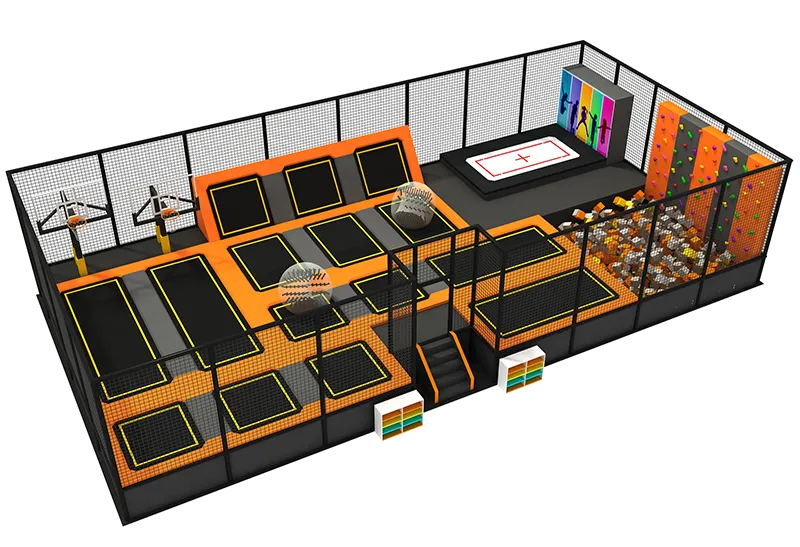
For operators managing multi-station trampoline courts, this kind of frame degradation rarely happens in isolation. It’s a fleet-wide problem that correlates with the original build quality and usage intensity. When you start seeing the same failure pattern across multiple bays, it’s time to think about a systemic upgrade rather than spot fixes. Planning a transition to equipment engineered for extreme duty cycles helps you break out of the repair loop.
Keep Your Springs Healthy Longer
-
Quarterly torque checks. Use a calibrated tension gauge, not just visual inspection. Document results.
-
Rotate usage zones. If your layout allows, rotate which trampolines serve as the primary landing zone for adjacent play features. Even 90-day rotations significantly equalize wear.
-
Pad coverage matters. Exposed springs collect dust that accelerates hook corrosion, even indoors. Frame pads aren’t just for impact protection — they’re a barrier against airborne contaminants.
-
Stock the right springs. Never substitute springs from a different manufacturer without verifying identical spring rate (kg/mm), free length, and wire diameter. A mismatched spring rate is worse than a missing spring.
When maintenance protocols are solid but equipment keeps failing, the issue isn’t your process — it’s the equipment’s design limits. That’s a hard realization, but a valuable one. It means you’re running at a volume where commercial-grade engineering actually pays for itself. If that describes your situation, it’s worth taking a closer look at Qilong’s approach to crafting indoor recreational environments that prioritize both safety performance and serviceability. Their integrated play solutions focus on reducing the maintenance burdens that eat into your margins, letting you put energy back into the guest experience.
Bottom Line
Misaligned trampoline springs are a fixable problem — until they’re not. Following a disciplined, documented realignment process keeps your equipment compliant with safety standards and your jumpers happy. But when the same springs keep failing and the frame shows its age, recognize the signal for what it is: a threshold you’ve crossed from routine maintenance into diminishing returns. At that crossroads, the smartest step isn’t a bigger toolkit — it’s a better foundation.
Disclaimer: This guide offers general maintenance advice based on industry practice and ASTM F2970-20 reference. Always follow the specific instructions provided by your equipment manufacturer and consult a qualified engineer for structural assessments.